A Jar's Second Use: Choosing a New Job for Glass
Choose a second use for a glass jar by matching its shape, opening and visibility to dry storage or display, without forcing it into an unsuitable job.
The common mistake with a clean glass jar is choosing a new job before looking at its shape and opening. That can leave a jar awkward to fill, difficult to clean, or hiding the very things it was meant to show. For a useful second use, judge the jar as a container first: what will pass through its mouth, how will it sit, and should its contents be seen?
This is a simple way to sort jars for dry storage or display without buying special organisers. A broad, stable jar may suit loose objects; a narrow-necked one may be better left as a vase or display vessel. The glass itself is only part of the decision. The opening and the view through the sides determine what the jar can do comfortably.
Start with the shape
Set the jar on a level surface and look at it from the side. A straight-sided jar is easy to line up on a shelf and makes its contents visible across much of the body. A jar that narrows towards the top can be attractive, but a hand or scoop may not reach easily inside. A rounded shoulder can make pouring slower and leave small pieces caught at the change in shape.
Base shape matters, too. A broad base gives a tall jar a steadier stance, while a small base beneath a high body can make it feel precarious when bumped. For display, that balance may be acceptable on a sheltered shelf. For frequently handled storage, a squat jar with a level base is often easier to use.
Notice whether the sides are smooth, ridged or deeply patterned. Ridges can add visual interest and make a jar easier to grip, but they interrupt the view and collect dust on the outside. A smooth-sided jar offers a clearer look at its contents and is easier to wipe. Neither is inherently better: the choice depends on whether the jar is mainly a container or part of a display.
Match the opening
The mouth controls the work of filling, retrieving and cleaning. A wide opening lets fingers, a small scoop or a cloth reach further inside. It suits items that are picked out individually, such as buttons, drawing pins or hair clips. A narrower mouth limits access, but can give stems a gathered appearance or frame a small display neatly.
Think about the largest item that needs to pass through the opening, not just the average one. If a jar is intended for pencils, check that the pencils can be placed and removed without scraping against the rim. If it is for dried lentils or rice, consider whether a spoon will fit and whether the contents can be poured without spilling. For tiny objects, a wide mouth may make retrieval easier but can also make the jar less suited to controlled pouring.
The rim deserves a quick look. A smooth, rounded lip is more comfortable to handle than a rough or chipped one. Do not assign a jar with damaged glass to ordinary household storage: set it aside for appropriate disposal or ask a local recycling service what it accepts. A lid is useful only if it fits properly and remains clean; a mismatched cap can turn a neat storage idea into a source of dust and loose contents.
Let visibility decide
Clear glass makes contents easy to identify, but it also puts them on show. That is helpful when a jar holds a small collection of attractive, regularly used items. It is less helpful for a jumble of odds and ends, or for anything that looks untidy as soon as the contents shift. A frosted or coloured jar softens the view, though it also makes it harder to tell what is inside.
Ask whether seeing the contents is a practical benefit or simply part of the look. A jar of wooden spools may add colour to a sewing shelf while keeping the spools visible. A jar of spare keys, by contrast, may be easier to manage in an opaque box or a drawer. If identification matters but the contents are not display-worthy, a simple paper label on the outside can be more useful than relying on memory.
Light changes the impression of transparent glass. A jar on a bright windowsill may catch reflections and make its contents appear less clear; one on an open shelf may be easier to read. Dust and fingerprints also show readily on clear surfaces. For a display jar, choose a place where it can be reached for wiping rather than wedged behind other objects.
Choose a dry-storage role
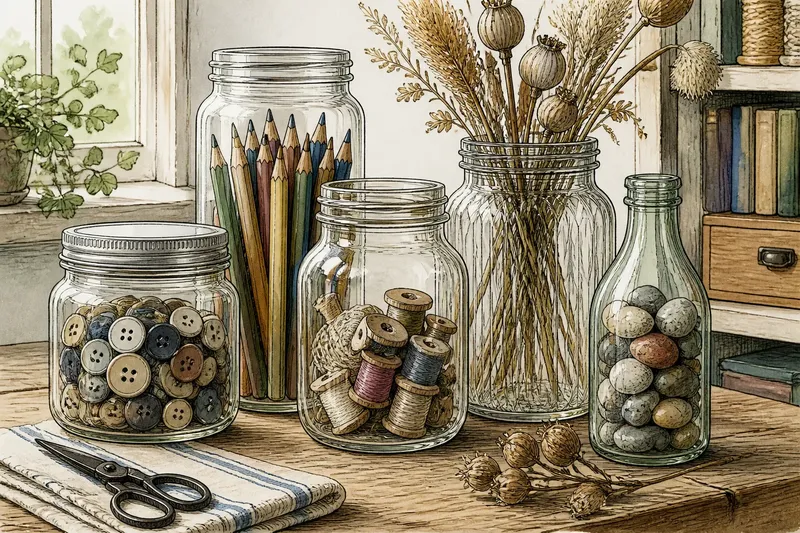
For dry storage, consider how often the contents will be handled and whether they need a lid. A broad-mouth jar can hold craft supplies, spare buttons or cotton reels where they are easy to see and reach. A taller jar can gather paintbrushes or pens, provided its base is stable and the tools do not press awkwardly against the glass. Small, light items are generally easier to manage than bulky objects that need to be forced through the mouth.
Keep the proposed contents dry and clean. A reused jar is not automatically suitable for preserving food, storing medicines or holding anything that requires controlled conditions. Those uses depend on the jar, lid and relevant handling guidance. For a straightforward household reuse, think instead of dry stationery, sewing notions, decorative stones or other non-perishable objects.
Say you have a clean, straight-sided jar with a wide mouth and a fitted lid, and a drawer full of spare buttons. You could place the jar on a nearby shelf so the buttons remain visible and can be reached by hand; the expected result is a small supply that is easier to identify than a loose jumble in the drawer. If the jar has no lid, the same choice may still work in a dust-free cupboard, but it is less suitable beside a busy work surface.
Give display its own purpose
A display use works best when the jar contributes something beyond simply holding an object. A handful of smooth beach pebbles, a few dried seed heads, or a compact collection of coloured beads can make the glass feel intentional. Leave enough space for the contents to be seen rather than packing the jar until its shape disappears.
Consider the scale of the objects against the vessel. Fine contents can look lost in a large jar, while oversized pieces may be difficult to arrange through a narrow opening. A jar with a shoulder or raised pattern can add shape to a sparse arrangement; a plain cylinder tends to let the contents lead. If the display looks cluttered, remove items rather than adding a decorative layer that obscures the glass.
For stems or dried flowers, the opening affects the arrangement: a narrower mouth gathers them, while a wide one allows them to spread. Keep the jar on a stable surface and avoid putting it where a passing sleeve or bag is likely to catch it. The purpose here is visual, so a location with a clear line of sight matters more than convenient access.
Which jar suits the job?
What makes a jar easier to use for storage?
A stable base, an opening wide enough for the contents and a shape that does not trap them are good signs. A fitted lid helps keep dust out, while a clear side helps identify what is stored.
Should the jar be clear or coloured?
Choose clear glass when quick identification or the contents’ appearance matters. Coloured glass can make a display calmer, but it hides details and may call for an outside label if the contents need to be recognised.
Can a narrow-necked jar hold small objects?
It can, if the objects pass through the mouth and can be retrieved without frustrating effort. If fingers or a scoop cannot reach them, reserve the jar for display or items that can be poured out easily.
Is a reused jar suitable for food storage?
Ordinary dry household storage is different from preserving food or keeping ingredients under controlled conditions. For those uses, follow the relevant product and food-safety guidance rather than assuming any clean jar and lid are suitable.
Ignore the perfect match
It is not worth searching for a jar that fulfils every possible role, or buying extra fittings to make an awkward one seem versatile. A jar can simply be good at one job. If its proportions suit a display but not storage, let that be enough; if it is useful but plain, keep it on a work shelf rather than dressing it up.
Before committing, place the empty jar where it might live and imagine reaching for it with the intended contents inside. Check that the opening is workable, the base sits securely, and the view through the glass helps rather than distracts. A second use for a glass jar is most successful when the vessel’s shape, mouth and visibility each support the same modest purpose. Once those three features agree, the choice is usually clear.