The Matching-Set Myth: Why Materials Need Not Match
Materials need not match for a room to feel coherent. Use contrast in texture, shape and visual weight to give familiar objects clearer roles.
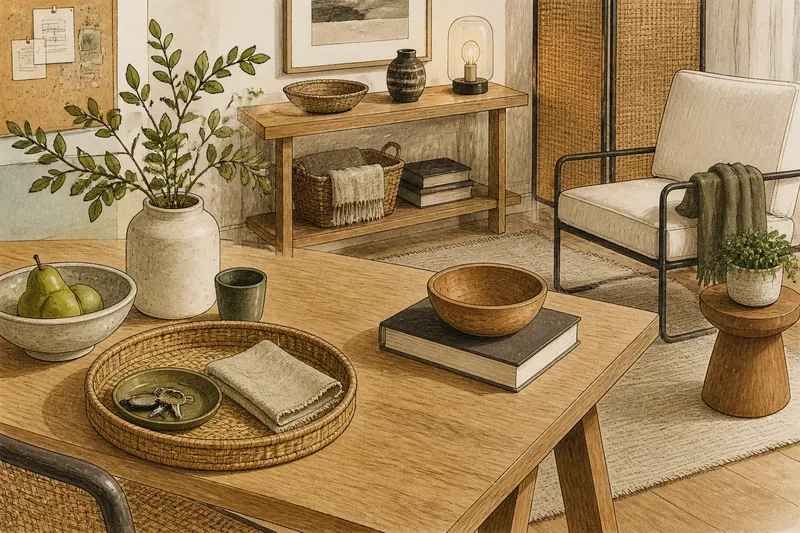
The common mistake in choosing materials is to treat a matching set as the safest route to a finished room. It can leave a table with no clear purpose, because every object competes for the same role. Materials need not match: a deliberate difference in scale, shape or use can give each piece a reason to be there.
Build a visual hierarchy
Start by deciding which object should lead. A large timber dining table can anchor a room; a small ceramic bowl can serve as a quiet counterpoint rather than another centre of attention. Hierarchy comes from the relationship between objects, not from collecting a different material for every surface.
One useful principle is to vary the role of a material, not merely its appearance. A woven basket can hold folded blankets, while a glazed dish gathers keys. Their different functions help distinguish them even if both sit on a wooden console. When objects share a task or silhouette, a change in material alone may not make the arrangement feel intentional.
Consider also how forms meet. A round vessel can soften the hard lines of a rectangular shelf; a narrow metal frame can give a broad upholstered chair a lighter outline. These relationships create structure without relying on shifts in colour or reflection.
Balance scale and form
Materials read differently according to the amount of visual space they occupy. A small rattan tray can add a fine, open pattern to a solid surface, while a broad rattan screen may become the room’s dominant element. Before adding another finish, consider whether the object’s size and outline already provide enough variation.
Repetition can make unlike materials feel related. A pair of round forms, such as a wooden stool and a ceramic planter, can share a shape while differing in substance. Alternatively, a repeated line—on a chair back, a picture frame and a table edge—can tie together objects that would otherwise seem unrelated.
A strong arrangement often has one leading feature and several supporting ones. If the table has a sculptural base, let nearby objects be simpler in outline. If the furniture is restrained, a vessel with an irregular rim can provide a small point of interest without turning the whole room into a collection of competing gestures.
Give objects distinct roles
Use and placement can clarify why a material belongs. A cork noticeboard near a desk has a practical role; a glass vase on a dining table has a different one. Their contrast is legible because each object answers a different need. This is a more durable design decision than choosing materials simply to create variety.
Say you have a pale birch desk, a clear acrylic lamp and a white ceramic pencil cup, and the arrangement feels indistinct. Move the lamp to the back corner to free the work surface, place the pencil cup beside the notebook it serves, and put a small dark-green felt mat under the cup. The expected result is a clearer working area: the lamp marks the edge, the cup has a defined place, and the mat separates its white form from the birch without requiring a new set of accessories.
When two objects seem to duplicate one another, change their jobs or positions before replacing either. A bowl used for loose change may be more useful by the entrance than beside another decorative dish. The decision then follows from daily use, rather than from a search for a perfect visual match.
Matching materials need not match?
How do I make different materials feel coherent?
Repeat a form, function or placement rather than trying to match every finish. For example, a group of objects with rounded outlines can feel connected even when one is timber, another ceramic and another metal.
Should furniture and accessories use the same wood?
No. Different woods can sit together if their shapes and roles are clear. If two pieces look like near-matches but have visibly different tones, give them separate positions or introduce a distinct material between them instead of trying to disguise the difference.
What should I change when a room feels cluttered?
First remove or relocate objects that repeat the same function or compete for the same surface. If the room still feels busy, simplify the shapes or reduce the number of small items before adding another material.
Is it worth buying matching accessories?
Only when the pieces solve a real organisational or practical need. Hunting for exact matches across objects with different purposes is not worth the effort; a clear arrangement and a shared visual feature usually do more.
Use a simple decision check
Before keeping, moving or buying an object, check what it contributes. Each observation should point to a choice, rather than becoming a rule that every room must follow.
- If two objects serve the same purpose on the same surface, keep the one used more often and move or store the other; if both are needed, give them separate locations.
- If an object’s outline disappears against the furniture behind it, move it to a clearer position; if the outline remains hard to read, place it against a surface with a different colour or shape.
- If several objects have equally prominent forms, choose one to lead and relocate or simplify the others; if their forms are already varied, leave the arrangement as it is.
- If a large accessory dominates a small area, remove it temporarily and compare the space; if the area becomes more useful, keep the accessory elsewhere, but return it if it serves a necessary function.
- If objects share a shape or practical role, use that connection to group them; if no clear connection exists, separate them rather than forcing a set.
- If a material choice requires frequent adjustment to remain tidy, reconsider the object’s location or purpose; if it works naturally where it is, keep the arrangement.
Matching materials need not match for a room to feel considered. The more useful question is whether each object has a distinct job, a place in the visual hierarchy and enough space to be understood. Let function and form make the connection; use a new finish only when it answers a real design need.