Woven or Knitted: Two Ways Cloth Takes Shape
Woven or knitted fabric behaves differently because of its structure. Learn to spot threads and loops, judge stretch, and choose cloth that suits your project.
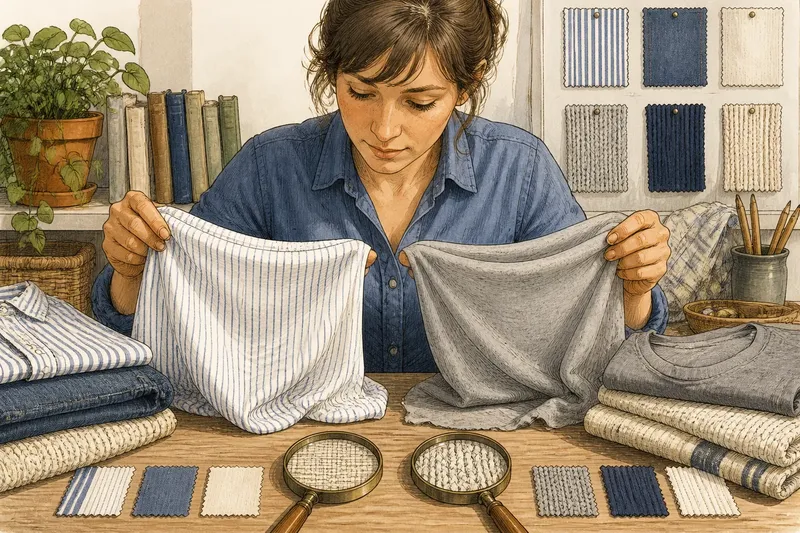
The common mistake with woven or knitted fabric is judging it by colour, weight or softness alone; the cost is choosing cloth that pulls out of shape, feels wrong against the skin or refuses to sit as intended. Look for crossing threads or connected loops instead. That first clue helps you understand how the material may respond, though it does not tell the whole story.
Woven and knitted structure
Woven cloth is made by interlacing two sets of yarns. The lengthwise yarns, called the warp, are held under tension on a loom; the crosswise yarns, called the weft, pass over and under them. Their crossings create a stable grid. Plain-weave cotton shirting, denim twill and satin are all woven, though their surfaces and drape differ because the threads cross in different patterns.
Knitted cloth is made from yarn bent into connected loops. In a hand-knitted jumper, the loops are visible as rows of stitches; in machine-made jersey, they may be fine enough to look smooth until you stretch the fabric gently. A loop can open or change shape under tension, so knitted material often gives more readily than a comparable woven one.
These are construction families, not promises about performance. A finely woven cloth cut on the bias may stretch diagonally, while a knit with firm yarns or a close structure may feel quite stable. Fibre, yarn twist, finishing and fabric weight all influence what the cloth does.
Read the fabric structure
Choose familiar items such as a cotton shirt, jeans, a T-shirt, a wool jumper or a tea towel. Look at an inconspicuous area in good light. Woven fabric commonly reveals a crossing grid, though prints, brushing and dense yarns can obscure it. Twill denim often shows diagonal ribs; plain-weave shirting tends to show a more regular crossing.
Knitted fabric usually shows rows of loops or small V shapes on one face. Jersey T-shirts often have a smoother face and a slightly ridged reverse. Rib-knit cuffs show alternating raised columns, which help them expand around a wrist and draw back in. If the surface is too fuzzy or patterned to read, turn the item inside out or examine an existing cut edge rather than guessing from appearance alone.
Compare woven or knitted fabric
Hold a shirt and a T-shirt by an unimportant edge. Pull each gently across its width, then along its length, and release. Notice whether the cloth yields, whether the edge rolls, and whether it returns towards its first shape. Do not yank: a hard pull can distort delicate cloth and tells you little about its normal behaviour.
Many plain woven fabrics have limited give in the warp and weft, while knitted jersey usually stretches more readily across the body. The amount and direction vary. Some woven trousers include elastane, and some knits are designed to be firm. Stretch is therefore a property to inspect, not a reliable shortcut for naming construction.
Say you are choosing fabric for a loose summer top and have two scraps: crisp woven cotton and soft cotton jersey. You gently draw each sideways, then drape each over your shoulder. The woven sample holds a sharper outline; the jersey yields and follows the curve more closely. If a relaxed, body-following fit matters most, the jersey is the stronger candidate; if you want a shirt-like shape with clearer edges, choose the woven sample. The visible trade-off is shape against give, not a universal ranking.
Texture and edge behaviour
Construction affects texture, but does not dictate it. A plain weave can feel smooth, rough or crisp depending on yarn and finish. A brushed knit may feel soft and raised; a fine jersey can feel sleek. Rub a small area between your fingers, then look for ridges, loops, floats or a brushed nap. These clues tell you about the surface the material presents, which matters for comfort, appearance and how it catches light.
Woven cloth often keeps a more defined edge and can hold a pressed crease or tailored line. Knitted cloth tends to drape around curves and may curl at an unbound cut edge, especially in jersey. Ribbing behaves differently again: its columns expand and contract, giving cuffs and neckbands a flexible finish. A decorative or textured surface may conceal the basic structure, so inspect more than one area if the distinction matters.
Look at an existing garment seam or fabric offcut. A woven cut edge may fray as individual yarns loosen; a knit may ladder or run if a loop breaks, though finishes and stitch types affect what happens. Overlocked seams, hems and binding can hide the raw edge, so a neatly finished garment may offer few visible clues without an inside view. Do not cut into a finished item just to identify it.
Choose cloth for its use
Think about the movement and outline you want. Woven cloth is often suited to shirts, structured skirts, table linens and light curtains, where a stable plane or crisp fold is useful. Knits commonly suit T-shirts, leggings, jumpers and cuffs, where stretch and drape can make movement easier. There are exceptions: a flowing woven dress and a dense knitted coat can both make sense because yarn, cut and construction work together.
For a sewing project, test a sample in the direction it will be worn or hung. Pin it loosely to a shoulder or drape it over a chair, then notice how it falls and whether it pulls at the intended seams. A small sample cannot reproduce the finished garment, but it can reveal stiffness, cling or a surface that feels uncomfortable.
- Check for crossing threads in good light; if a grid is visible, treat woven construction as the leading possibility, otherwise inspect the reverse or an existing edge.
- Check for connected loops or V-shaped stitches; if they appear, treat knitted construction as the leading possibility, otherwise look at a less fuzzy section.
- Check widthwise stretch with a gentle pull; if the cloth yields readily, consider a design that benefits from give, otherwise assess whether the intended fit allows movement.
- Check lengthwise stretch the same way; if it differs noticeably from widthwise stretch, orient a sewing sample accordingly, otherwise test its drape before choosing a cut.
- Check an existing raw edge; if threads fray, handle the sample as a likely woven fabric, otherwise inspect for loops and avoid assuming that a finished edge proves it is knitted.
- Check how a sample hangs over a shoulder or chair; if it keeps the intended outline, it may suit a structured design, otherwise consider a softer cut or a different cloth.
Questions about fabric structure?
How can I tell woven cloth from knitted cloth?
Look for threads crossing at right angles in woven fabric, and connected loops in knitted fabric. A close look at the reverse, a ribbed section or an existing cut edge can make the structure easier to see.
Does knitted fabric always stretch more?
No. Knits often give because their loops can change shape, but yarn, stitch density and finishing affect the result. Some woven fabrics also stretch, particularly when they contain elastic fibres or are cut on the bias.
Why does jersey curl at the edge?
In many jersey knits, the loop structure makes an unfinished cut edge roll towards one side. The amount varies with the fabric, and a hem or binding can keep the edge controlled in a finished garment.
Which construction is better for clothing?
Neither is better in general. Woven cloth can provide a defined shape, while knitted cloth often offers more give and a closer drape; the intended fit, movement and surface matter more than a single rule.
Keep a useful fabric note
Set aside a small scrap from a future sewing project, or make a note about an old garment before it is discarded. Record what you can observe: visible crossings or loops, stretch direction, edge behaviour and how the surface feels. A simple label such as “cotton, woven, little widthwise give” is more useful later than a guess based on whether the cloth feels thick or soft.
It is not worth pulling apart a sound garment, buying specialist magnification or trying to identify every weave and stitch before choosing everyday clothing. Start with the visible structure and the way the cloth responds to a gentle touch. Knowing how woven or knitted fabric behaves gives you a clearer basis for choosing and sewing with the cloth already around you.