Why Paper Holds a Crease: Fibre Direction and Fold Sharpness
Why paper holds a crease depends on fibre direction and fold sharpness. Learn how grain and pressure affect folding, so you can make cleaner folds with less surface damage.
The common mistake with a stubborn sheet is to press harder along the same fold, even when the paper is bending against its grain. That can leave a rough ridge, split the surface or make a neat fold harder to achieve. Why paper holds a crease depends partly on how its fibres lie and partly on how the fold changes the sheet’s layers.
Fibres beneath the surface
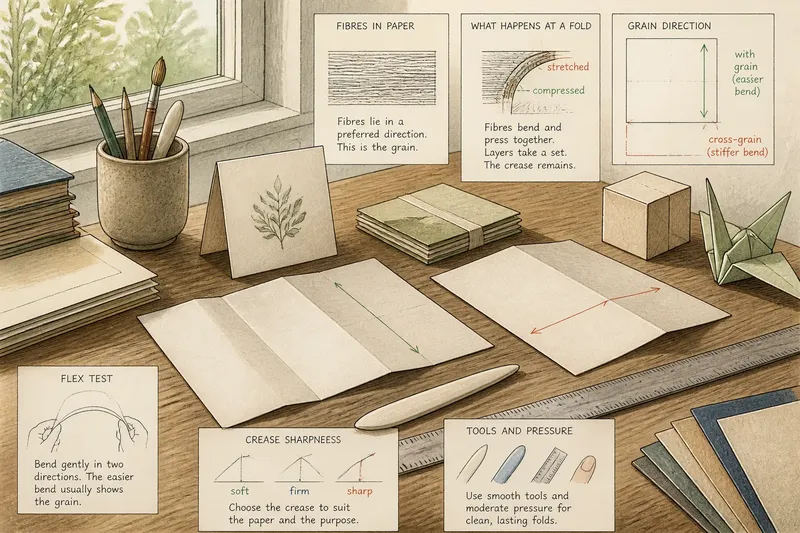
Paper is made from plant fibres dispersed in water and pressed into a thin mat. As the sheet forms and dries, many fibres tend to settle in a preferred direction. This is called the grain. It is not a visible stripe or a row of fibres running perfectly parallel; it is a general orientation that makes the sheet respond differently along one axis than across it.
When you fold paper, the material on the outside of the bend is stretched while the material inside is compressed. At the fold line, fibres shift, bend and press against one another. The sheet’s surface layers also take on a lasting set. After the paper is opened, that altered structure resists returning to its original flat shape, so the crease remains visible and the paper tends to fold there again.
The change is not simply a row of broken fibres. A clean fold usually involves bending and compression across a narrow zone, with some local fibre damage possible. A hard, blunt crease can crush the sheet; an overly sharp or repeated fold can weaken it until fibres separate and the paper tears.
Grainwise and cross-grain
A fold made parallel to the grain is often easier to form cleanly. The paper tends to bend with less resistance, and the fold line is less likely to look ragged. Folding across the grain can feel stiffer and may leave a more uneven ridge, particularly in thick stock, though the precise result depends on the paper’s finish, thickness and composition.
This difference matters in different ways for different tasks:
- Cards and covers: Grainwise folds usually suit heavier paper that needs a tidy hinge and a smooth outer surface.
- Origami and repeated shaping: A sheet that folds cleanly in several directions is often more useful than one chosen only for a single, strong crease.
- Forms and handouts: For a simple fold, the sheet may be entirely serviceable either way; appearance and handling matter more than perfect grain alignment.
Paper sellers may describe stock as long-grain or short-grain, terms that refer to the grain’s orientation relative to the sheet’s dimensions. The exact convention can vary by format and supplier, so check the product description when direction matters. For an unlabelled sheet, a gentle bend test can help: hold it near an edge and flex it slightly in each direction without making a crease. The direction that bows more readily is usually along the grain. Treat this as a clue, not a precise measurement.
Choosing crease sharpness
A crease can be soft, firm or sharply defined. A soft fold is useful when a sheet must open and close without a conspicuous ridge. A firm crease gives a card or envelope a clearer hinge. A very sharp crease can help a small model hold its shape, but on delicate or coated paper it may leave a bright line, crack the surface or expose fibres.
The tool and the pressure both affect the result. A bone folder, a smooth plastic creasing tool or the rounded edge of a clean ruler can press a fold evenly. A fingernail can work for light paper, but concentrated pressure may leave a polished mark. Use a metal edge gently: a sharp corner can cut or score rather than crease. For coated or brittle stock, make a light test fold on an offcut before committing to the visible face.
Say you are making a folded invitation from uncoated card. The first blank bends more readily in one direction, so you orient the fold that way, bring the edges together without dragging them, and run a bone folder lightly along the line. The expected result is a cleaner hinge with less surface stress than a forceful fold made against the grain. If the card still feels resistant, a gentler crease is preferable to repeatedly grinding the same line.
Paper grain and creases
How can I find the grain?
Flex an unmarked sheet gently in two directions, supporting it near the edge. The easier, softer bend usually indicates the grain direction; avoid pressing hard enough to make a permanent fold.
Should I fold with the grain?
For a clean fold in card, covers or other substantial paper, folding parallel to the grain is often the better starting point. For a quick fold in ordinary thin paper, the difference may be small enough that layout or convenience decides.
Why does a crease turn white?
A pale line can appear when bending stretches or disrupts the surface coating or fibres, changing how light reflects from the fold. It is more noticeable on dark, coated or brittle stock, and further pressure may make the mark worse.
Can I remove a crease?
Opening the sheet can flatten it somewhat, but the changed fibres and compressed layers remain, so the old line may still show. Avoid wetting or ironing paper casually: moisture and heat can warp, stain or damage it, especially if the sheet is printed or coated.
Choosing the right approach
For a polished card or a cover that will be handled repeatedly, find the grain and make a controlled crease with a smooth folder. For lightweight paper used once, a simple hand fold is usually enough. For a model with many intersecting folds, prioritise stock that bends predictably in more than one direction, then use moderate pressure rather than chasing the sharpest possible lines.
Not worth the effort: trying to identify the grain of every sheet in a casual stack of printer paper. Save the check for folds where the finish, thickness or repeated handling makes a visible difference.
The useful rule behind why paper holds a crease is that the fold becomes a local change in the sheet, not merely a line drawn across it. Match the fold direction to the paper when neatness matters, and let the intended use set how firmly you press. A crease should guide the sheet’s shape without damaging the surface it is meant to preserve.